
Common Timing and Sequencing Mistakes in Step 3 CCS
Timing and sequence can affect credit even when an action is clinically appropriate. This guide explains common workflow risks and practical habits for addressing them.
Ask candidates what worries them about CCS and most describe a knowledge problem: an unfamiliar presentation, a diagnosis they will not recognize, a drug they will not remember. Ask people who have reviewed a lot of practice attempts and they will describe something different — a workflow problem.
The recurring picture is a candidate who knew the medicine and still produced an incomplete case. The diagnosis was right. The treatment was right. The order in which things happened was not.
CCS is unusual among medical exams in that it assesses a sequence rather than an answer. That makes the failure modes predictable, which is good news: predictable errors respond to drilling. Below are the eleven that turn up most often, grouped by what causes them.
In this article
Why sequencing is scored at all
The CCS format exists because a multiple-choice question cannot capture how a physician actually manages a patient. These are interactive simulations in which you manage a patient over simulated time, and the USMLE describes a case as ending when you have "demonstrated your skills sufficiently" or run out of real or simulated time.
Over time is the operative phrase. The simulation records not just what you did, but when — relative to the patient's condition and to everything else you did. A defensible order of operations is part of what is being assessed, and it is the part most candidates never explicitly practice.
Errors of order: doing the right thing second
1. Working up before stabilizing. An extensive diagnostic workup can delay the treatment an unstable patient needs. Address immediate threats while selecting the tests that will change management.
The fix: assess airway, breathing and circulation, then select indicated support, vascular access, monitoring and time-critical treatment. Tailor these actions to the presentation; oxygen and fluids are not automatic orders for every patient.
2. Waiting for confirmation before starting empiric treatment. In conditions where delay causes harm, treatment precedes certainty. Suspected bacterial meningitis, sepsis, anaphylaxis, hypoglycemia, tension physiology, opioid toxicity — the confirmatory step does not gate the therapeutic one.
The fix: for each high-acuity presentation you study, note explicitly which action must not wait for a result. That list is short and highly repetitive across cases.
3. The diagnostic detour. Ordering an elegant confirmatory study that delays definitive management. It looks thorough. In a time-based simulation it reads as a delay, because that is exactly what it is.
The fix: before ordering any test, ask what you will do differently based on the result. If the answer is "nothing, I would treat either way," the test is not wrong, but it is not urgent — and it should not sit in front of treatment.
4. Batch-ordering at minute one, then coasting. A large order set placed immediately can feel efficient. The problem is that it front-loads decisions you do not yet have information for, and it usually contains items that become inappropriate once the picture develops.
The fix: order in small, purposeful groups tied to the current question. Management is a conversation with the patient's physiology, not a single transmission.
Errors of the clock
5. Treating and never looking. An intervention with no subsequent reassessment is one of the most frequent gaps in practice feedback. The medication was correct, the dose was correct, and nobody ever checked whether it worked.
The fix: couple every intervention to a reassessment. Treat, advance the clock, look at the vitals, repeat the relevant focused examination or measurement. Reassessment is a scoreable action, and it also happens to be how you catch the case that is going the wrong way.
6. Advancing past the moment. Because you must advance the clock to make anything happen, it is also possible to advance past the window in which an action would have been timely. The order still gets placed. It just arrives late.
The fix: before each advance, run the check — is anything time-critical still unordered, is the patient in the right place, and have I actually ordered the thing whose result I am waiting for? More on choosing the interval here.
7. Full head-to-toe examination on an unstable patient. Interval history and physical examination requests automatically advance simulated time, and the interface tells you how much time a given component will take. A comprehensive examination is therefore a time decision as well as a clinical one.
The fix: examine focally and purposefully. Ask what finding would change your management, and examine for that.
Advance simulated time deliberately. Clinical deterioration can occur during a time jump, so match the interval to the patient’s condition and the next reassessment needed.
The fix: interface fluency. Practice entering orders until typing them is automatic, so real time goes to thinking rather than to hunting.
Errors of place
9. Right management, wrong setting. Location is a scored dimension of CCS management, and it is easy to leave a patient in a setting that no longer matches their needs — an ICU-level patient still in the emergency department, a stable patient occupying a critical care bed, an outpatient scenario managed as if it were inpatient.
The fix: make location a running question. Every time you advance the clock, ask whether the patient is still in the right place for what you have just decided.
10. Discovering the location problem too late. Once the case-end instructions screen appears, you can no longer change the patient's location or schedule a follow-up appointment. A disposition realized in the closing period is a disposition that cannot be acted on.
The fix: place the disposition and any follow-up appointment as soon as the patient is stable and definitively treated — not as a closing gesture.
Location and follow-up are the two decisions with a hard deadline earlier than the end of the case. Treat them as mid-case items.
Errors of closure
11. Saving prevention and counseling for the end. Vaccination, smoking cessation, alcohol counseling, adherence, diet and exercise, safe sex, injury prevention, VTE prophylaxis — none of them ever feels urgent, so all of them get deferred. Then the case-end prompt arrives and there is no time to defer to.
The fix: run a fixed closing sweep on every case, and place the items that are already obvious as soon as they become obvious rather than at the end. A smoker with an acute coronary syndrome does not need you to wait until minute nine to decide that smoking cessation counseling is indicated. The full closing sequence is here.
Quick reference table
| Error | What it looks like in feedback | The habit that fixes it |
|---|---|---|
| Work-up before stabilization | Essential early action missing or late | Fixed opening set on any unstable patient |
| Waiting for confirmation to treat | Definitive therapy late | Know the "do not wait" action per presentation |
| Diagnostic detour | Out of sequence | Ask what the test changes before ordering it |
| Batch ordering at minute one | Unnecessary or inappropriate actions | Order in small purposeful groups |
| No reassessment after treatment | Monitoring gap | Treat → advance → look, every time |
| Advancing too far | Correct actions marked late | Pre-advance check |
| Comprehensive exam when unstable | Time lost, deterioration missed | Focused examination only |
| Hesitating over the order sheet | Case ends before management is complete | Drill order entry until automatic |
| Wrong care setting | Location error | Ask "right place?" at every advance |
| Late disposition | Disposition locked at case end | Place it as soon as the patient is stable |
| Prevention deferred to the end | Missed counseling and prophylaxis | Review the same categories; order only indicated care |
How to find your own pattern
Generic advice about sequencing helps less than knowing which of these eleven is yours. Almost everyone has two or three that recur, and they tend to be stable — the candidate who advances too aggressively does it in every case, not occasionally.
Finding your pattern requires two things that ordinary studying does not provide.
A record of when, not just what. A score tells you the case went badly. A timestamped list of what was missed, what was late and what was out of sequence tells you which habit produced it. Those are very different pieces of information, and only the second one is actionable.
Enough repetitions for a pattern to be visible. One case is an anecdote. Fifteen cases reviewed the same way is a diagnosis. This is the argument for frequent short practice over occasional long sessions: the point is not the hours, it is the number of independent observations of your own workflow.
Then the fix is narrow. If your errors cluster in monitoring, drill treat-advance-look until it is reflexive. If they cluster in location, put "right place?" on a sticky note. You are not trying to become a better physician in the abstract — you are trying to remove two specific habits.
Making the pattern visible
An error log that sorts by what keeps happening
CCS Orbit is a mobile-first Step 3 CCS practice app that scores each attempt across six domains — diagnosis, treatment, monitoring, timing, sequencing and location — and labels individual decisions as strong, missed, late, out of sequence, a monitoring gap, a wrong setting, or unsafe.
Those labels feed an error log you can filter by issue type and sort by frequency, recency or domain, so a recurring habit surfaces as a ranked list rather than a hunch. Focus Mode shows cases matched to your weakest measured domain and lets you choose another focus. With 120+ interactive cases and three free cases at launch, it is built for short, repeated practice between other commitments.
Three cases are free. Orbit Plus offers a 60-day Exam Pass for US$34.99 or lifetime access for US$59.99. These are the only two paid options. Both are one-time purchases with no automatic renewal or monthly subscription. Regional prices and applicable taxes appear in the App Store purchase sheet. See Orbit Plus options.
Available on the App Store soon. Get one email at launch →
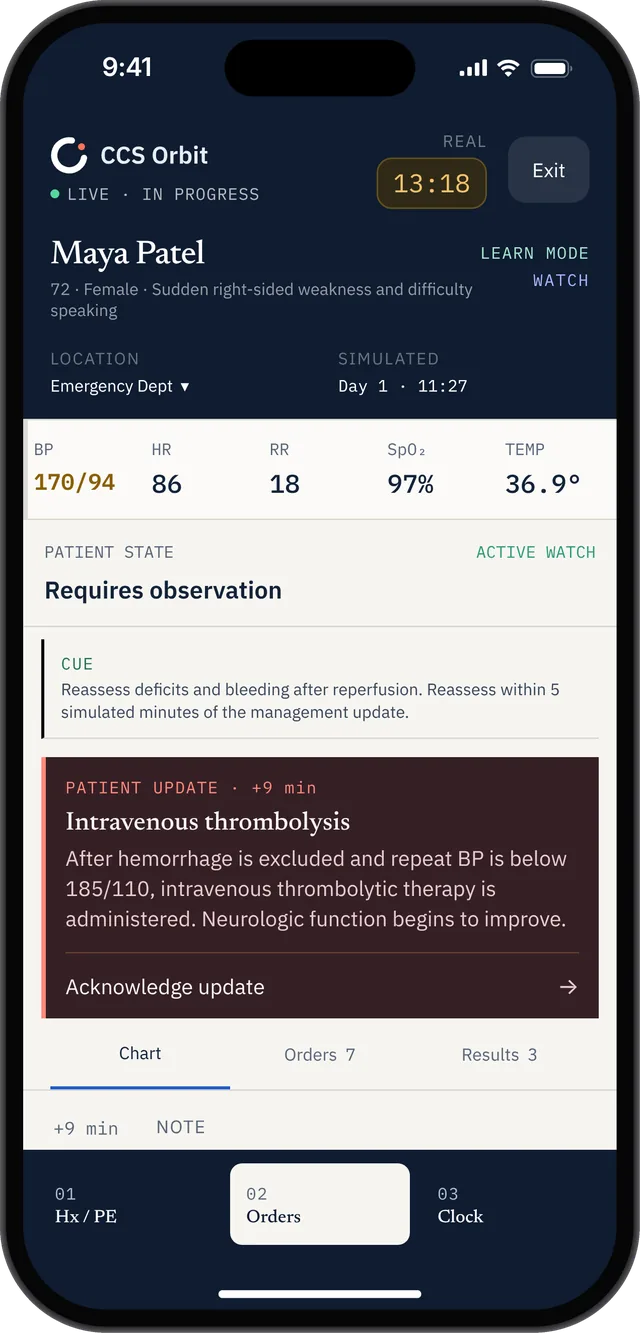
A patient update, updated vital signs and a Learn mode cue connect treatment to the next reassessment.
FAQ
Is CCS scored on the diagnosis or on the management?
CCS presents interactive simulations in which you manage a patient over simulated time rather than select an answer. The exact scoring methodology is proprietary and no study resource can reproduce it, but the format itself makes clear that the sequence of management decisions is what is being observed.
Does ordering unnecessary tests hurt my score?
The USMLE does not publish how individual actions are weighted, so treat any specific claim about point deductions with caution. What is defensible is the clinical principle: a focused, indicated set of actions represents better management than a broad defensive one, and unnecessary orders consume real time you cannot get back.
What is the difference between a "late" action and an "out of sequence" action?
These are practice-feedback distinctions rather than official USMLE labels. Broadly, a late action is one that was right but arrived after the window in which it would have helped; an out-of-sequence action is one placed before something that should have come first — imaging ahead of stabilization, for example. Both usually trace back to the same root cause: advancing the clock without a pre-advance check.
How many practice cases should I do before test day?
There is no official number, and it depends on how much of your difficulty is clinical versus mechanical. A practical benchmark is enough repetitions that the opening set, the advance-and-reassess loop and the closing sweep happen without conscious effort — and that you have reviewed your own errors often enough to name your two recurring habits.
Do I need to practice on exam-like software, or is reading cases enough?
Reading case write-ups builds clinical reasoning but does not build interface fluency, and interface fluency is what protects your real-time budget. The USMLE offers practice cases through its own interactive testing experience, and working through those is the most direct way to rehearse the actual mechanics before test day.
Keep reading
Sources
- USMLE, Computer-based Case Simulations — case mechanics, clock advancement, interval history and physical examination, case-end restrictions.
- USMLE, How to Run a Step 3 CCS Case (video transcript, PDF) — running a case, location changes, the case-end alert.
- USMLE, Common Questions: Step 3 CCS — how a case ends.
- USMLE, Step 3 Formats and Questions — what CCS assesses.