
CCS Reassessment: What to Check After You Start Treatment
Choose what to recheck, interpret the response and make the next management decision. A practical guide to reassessment in Step 3 CCS.
You have recognized the problem and entered the treatment. What happens next is where a CCS case becomes more than an order list. CCS reassessment means checking the patient's response, looking for treatment complications and deciding whether the plan still fits. This guide gives you a practical way to do that, with worked examples and a checklist you can use in your next practice case.
Key takeaways
- Choose the finding you need to recheck when you start treatment. It might be breathing, perfusion, glucose, potassium, pain or a specific examination finding.
- Match the reassessment interval to the patient's risk and the expected treatment response. There is no universal “advance 30 minutes” rule.
- Read the new findings and act on them. A repeated test is useful when its result informs a decision.
- Finish necessary reassessment while the case is active. The official case-end screen limits what you can do next.
What reassessment actually involves
Think of reassessment as three questions:
- Did the problem improve? Compare relevant symptoms, examination findings, vital signs and results with the starting point.
- Did treatment create a new problem? Consider adverse effects and changes that require monitoring.
- What should I do now? Continue, adjust, escalate, investigate further or move toward disposition.
This is different from repeatedly ordering a full examination. A patient treated for a respiratory problem needs a meaningful respiratory review. A patient receiving therapy that changes glucose or electrolytes needs the relevant measurements. Each recheck should have a purpose.
Our CCS clock-management guide explains the timing controls. Here, the focus is what you do with the information after time passes.
The official CCS mechanics to remember
In the official software, interval history and physical examination requests advance simulated time automatically. Deliberate clock advancement lets you receive pending results and observe treatment effects. “Call/See me as needed” should not be treated as a monitoring order. If an advance to a scheduled appointment is interrupted, the appointment is canceled; reconsider the follow-up plan. [1]
Once the case-end instructions appear, you cannot perform another physical examination or interval history, change location, arrange a follow-up appointment or advance simulated time to observe new results. You can review the chart and add or cancel orders. Complete the assessments that inform disposition before this stage. [1]
The habit to develop is simple: before moving time forward, identify what you expect to learn and what would make you change course.
A four-step reassessment loop
1. Establish a useful baseline
Identify the findings that describe the patient's current problem. For a breathless patient, “short of breath” is less useful than a description that includes respiratory effort, oxygenation and the relevant chest findings. For a patient with circulatory compromise, consider the evidence of impaired perfusion as well as the blood-pressure reading.
You do not need to restate the entire history. You need enough information to recognize a meaningful change.
2. Connect treatment to a measurable response
Ask what success would look like and what could go wrong. Write the answer mentally in one sentence:
After this intervention, I will reassess the relevant symptoms and objective findings, then decide whether the patient needs further treatment or escalation.
Replace “relevant findings” with the actual findings for your case. The sentence is a learning prompt, not a phrase to type into the order box.
3. Choose an interval that fits the risk
An unstable patient may need rapid, repeated review. A stable outpatient treatment plan may require follow-up over a much longer period. A pending test's report time matters, but it does not remove the need to address immediate deterioration.
Avoid choosing an interval simply because it worked in a different practice case. Ask whether the patient can safely wait and whether the information you need will be available by then.
4. Make the next decision
A reassuring update can support continuing the plan, but do not let one improved measurement stand in for the whole assessment. If findings worsen or fail to improve, check the diagnosis, treatment delivery, complications and need for a higher level of care.
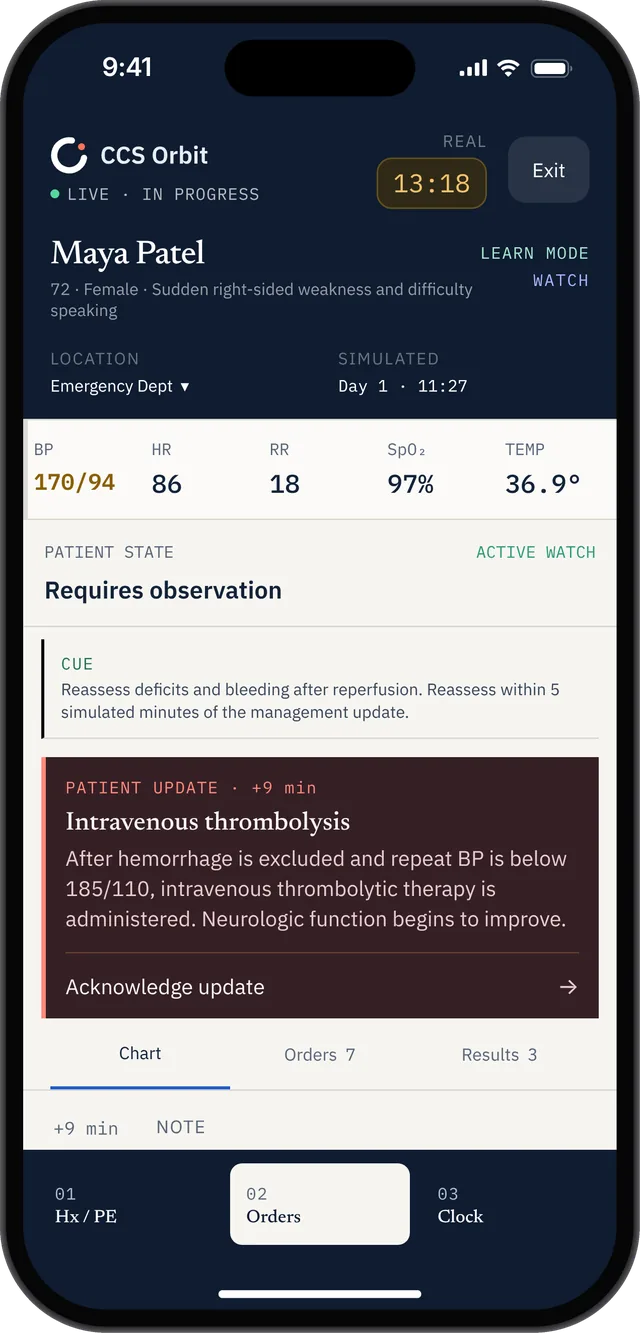
Worked example 1: asthma after initial treatment
Consider a practice patient with an asthma exacerbation who has received appropriate initial therapy. Your next task is to determine whether breathing has improved sufficiently or whether the patient needs further intervention.
Review respiratory effort, respiratory rate, oxygenation and the relevant chest findings. Compare the findings with the baseline rather than looking only for the word “better.” Persistent distress or deterioration should change your management and disposition decisions.
This is not merely a study preference: the official USMLE sample asthma case specifically includes a repeat chest/lung examination after treatment as part of monitoring. [2]
The learning point: entering the initial medication is one action; demonstrating that you checked its effect is another. Neither improvement nor an early case ending should be used as a substitute for reviewing what you actually did.
Worked example 2: DKA with improving glucose
A falling glucose result can look reassuring while other treatment goals remain unfinished. In DKA, review the metabolic response, electrolytes, hydration and clinical status rather than using glucose alone as your endpoint.
The 2024 international hyperglycemic-crisis consensus recommends glucose checks every 1–2 hours during treatment and blood sampling every 4 hours for electrolytes, phosphate, creatinine, beta-hydroxybutyrate and venous pH until DKA resolves. These are clinical guidance intervals, not a universal CCS clock setting. [3]
The same report emphasizes that DKA resolution depends on ketone and acid-base criteria. Do not assume that a lower glucose means ketoacidosis has resolved, or use urine ketones alone to judge recovery. [3]
The learning point: before advancing time, identify both the response you want and the treatment complications you need to detect. This example illustrates monitoring logic, not a complete DKA treatment protocol.
Worked example 3: sepsis after initial fluids
After an initial fluid intervention, reassess whether perfusion improved and whether the patient is tolerating the treatment. Consider blood pressure, mental status, clinical perfusion, urine output when relevant and signs of fluid intolerance. Persistent shock needs active reconsideration of support and the underlying cause.
The 2026 Surviving Sepsis Campaign emphasizes frequent reassessment during fluid resuscitation and favors dynamic measures to help guide further fluids when available. Serial lactate can contribute, but additional fluid should be individualized rather than continued automatically until lactate normalizes. [4]
The learning point: “fluids ordered” is not the same as “resuscitation completed.” A new result should lead to a decision about the next step, not another automatic copy of the opening orders.
A practical reassessment checklist
| Question | What to look for | What the answer changes |
|---|---|---|
| Has the main problem improved? | The relevant symptoms, examination and objective measures | Whether to continue or adjust treatment |
| Is the patient tolerating treatment? | Condition-specific adverse effects and monitoring results | Whether to modify therapy or add safeguards |
| Is the working diagnosis still plausible? | Findings that support or contradict it | Whether to investigate an alternative or complication |
| Is the current location appropriate? | Stability, monitoring and treatment needs | Whether to escalate or plan a safe transition |
| What remains unresolved? | Pending results, persistent abnormalities and follow-up needs | The next reassessment point and disposition plan |
Use the table to organize your thinking. It is not a universal set of orders, and not every row requires a new test.
Common reassessment mistakes
Repeating everything instead of answering a question. A long list of repeat tests can obscure the specific information you need. Choose checks that fit the condition and the decision.
Waiting for a test while ignoring the patient. A future report time does not make an unstable patient safe to leave unassessed.
Reading the update without responding to it. If the patient is worse, reconsider the plan before making another large time jump.
Treating symptom improvement as permission to discharge. Confirm that remaining risks, treatment needs and follow-up support the disposition.
Saving reassessment for the final screen. By then, the actions needed to establish readiness for discharge may no longer be available. See our final two-minute guide for that stage of the workflow.
How to practice this in CCS Orbit
Use your next CCS Orbit case to rehearse one complete loop: identify the problem, order appropriate treatment, advance time deliberately, reassess and decide what comes next. The app's iPhone format and offline cases make it practical to work on that loop in a focused study session.
After the case, review the debrief for missed or delayed actions. Write down whether the gap was choosing the right check, choosing the interval or responding to the result. That gives you a more useful repeat-case goal than simply aiming for a higher percentage.
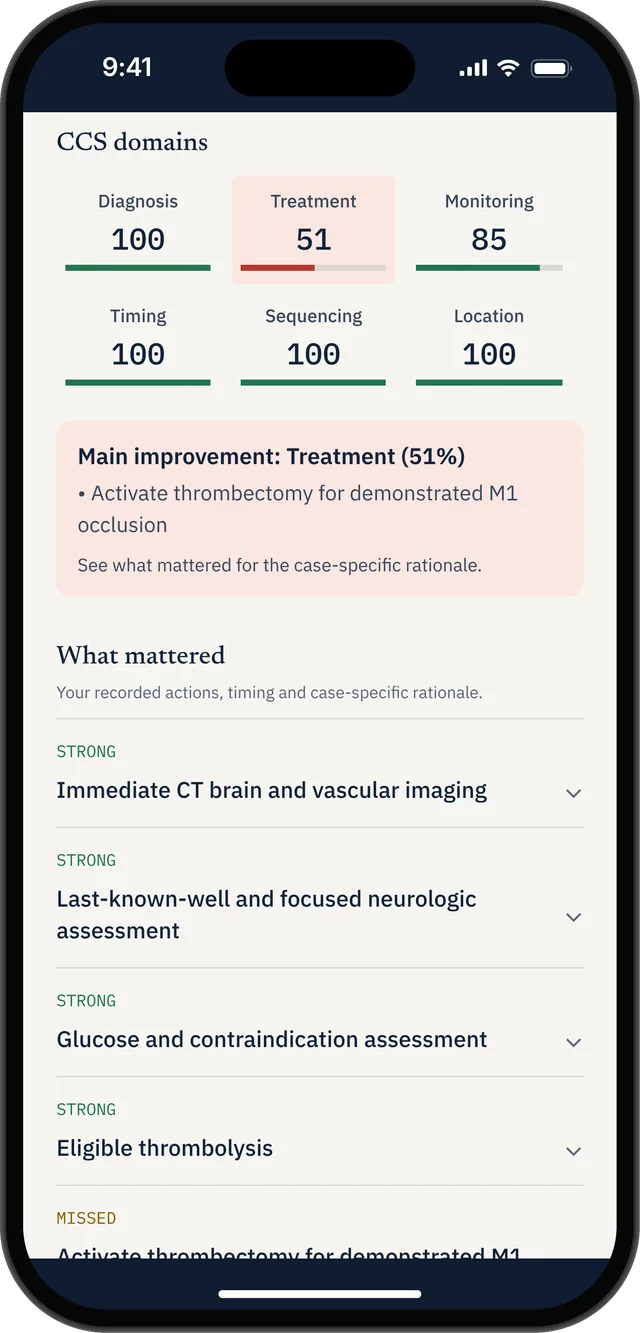
Our guide to reviewing a CCS practice case walks through that process. You can also explore how CCS Orbit works, including its case workflow and feedback.
Frequently asked questions
Should I repeat the full physical examination after every treatment?
Choose examination components for a clinical reason. A focused reassessment is often more informative than repeating unrelated components, particularly when time and instability matter.
Is there one correct interval for reassessment in every CCS case?
No. The appropriate interval depends on the problem, urgency, expected response and pending information. A monitoring interval from one condition should not become a default for every case.
Does clicking reassess guarantee points?
Do not assume any single click guarantees credit. Practice the complete clinical task: obtain relevant information, interpret it and adjust management when indicated.
Sources
- USMLE: Common Questions, Step 3 CCS mechanics and case-end restrictions.
- USMLE: Computer-based Case Simulations and sample-case feedback.
- ADA and partner societies: Hyperglycemic Crises in Adults With Diabetes, 2024 consensus report.
- Society of Critical Care Medicine: Surviving Sepsis Campaign adult guidelines, 2026.
Clinical examples are for exam preparation and illustrate reassessment principles; they are not complete treatment protocols. Sources checked October 17, 2026.