
The First Five Orders: CCS Opening Sets by Presentation
A structured opening helps you prioritize urgent care, appropriate monitoring and the next useful test. These examples require adjustment to the patient’s findings and contraindications.
Begin by assessing stability and identifying the action that cannot safely wait. Familiarity should reduce hesitation without replacing clinical judgment.
A practiced framework can make the opening more efficient. It must still respond to the clinical problem: oxygen, fluids and invasive monitoring are not universal orders.
Use the framework to organize your reasoning, then select only the actions this patient needs.
What this is and is not. This is exam-preparation framing for practicing CCS workflow, not a clinical protocol and not medical advice. Real management depends on the individual patient, and current guidelines from the relevant specialty bodies govern. Case specifics always override a generic opening set — a contraindication in the vignette beats a habit every time.
In this article
Why five
Five is arbitrary. It is also useful, for two reasons.
It is enough to cover stabilization, the immediately decisive test and the immediately decisive treatment in most acute presentations. And it is few enough to force prioritization. A candidate allowed twenty opening orders will place twenty, most of which are noise. A candidate allowed five has to decide what actually matters in the first minute — which is exactly the judgment being assessed.
Treat it as a forcing function rather than a rule. If a case needs six, place six. If it needs three, do not manufacture two more.
The universal opening frame
Before any presentation-specific knowledge, there is a frame that fits nearly every unstable patient:
The frame
- Support what is failing. Airway, breathing, circulation. Oxygen if hypoxic, positioning, assistance with ventilation if needed.
- Get access. Intravenous access — two large-bore lines if bleeding or shocked.
- See the trend. Cardiac monitoring, continuous pulse oximetry, blood pressure monitoring. Orders, not intentions.
- Get the one decisive test. The single study that changes what you do in the next two minutes.
- Give the one decisive treatment. The intervention that should not wait for confirmation.
Note the shape: two orders that make the patient safer, one that makes them observable, one that resolves your immediate uncertainty, one that treats. That distribution is deliberate, and it is a reasonable default even when you are not yet sure what you are dealing with.
Two more universals worth building into the frame:
Glucose. Cheap, fast, and it explains a startling fraction of altered patients. Check it early in anyone confused, weak, seizing or unwell without explanation.
Pregnancy status. In any patient of reproductive age with abdominal or pelvic symptoms, unexplained shock, or where you are about to order imaging or a teratogenic drug. Omitting it is one of the more consequential misses available.
Opening sets by presentation
The table below gives a defensible first move for ten presentations that recur in Step 3 preparation. Read the last two columns carefully — the "do not wait" action and the classic omission are where cases are actually won and lost.
| Presentation | A reasonable opening set | Do not wait for confirmation to | Classic omission |
|---|---|---|---|
| Undifferentiated unstable patient | Oxygen if hypoxemic; IV access; cardiac monitor and pulse oximetry; fingerstick glucose; ECG | Support airway, breathing and circulation | Glucose |
| Acute chest pain, suspected ACS | ECG; IV access; cardiac monitor and pulse oximetry; aspirin if appropriate and not contraindicated; troponin | Obtain the ECG and give aspirin | Deciding on a reperfusion strategy promptly |
| Suspected sepsis | IV access; blood cultures; IV fluids; broad-spectrum antibiotics; lactate and CBC | Give fluids and antibiotics — cultures first if it does not delay them | Source identification and control |
| Acute stroke symptoms | Fingerstick glucose; non-contrast head CT; IV access; cardiac monitor and pulse oximetry; neurology consultation | Establish time of symptom onset and image the head | Time of onset, swallow and NPO status, blood pressure targets |
| Diabetic ketoacidosis | IV access; IV isotonic fluids; BMP with potassium; venous blood gas or bicarbonate; insulin after potassium is checked and safely corrected if low | Start fluid resuscitation | Checking potassium before insulin; the precipitant |
| Anaphylaxis | Intramuscular epinephrine; oxygen; IV access; cardiac monitor and pulse oximetry; IV fluids if hypotensive | Give intramuscular epinephrine | Observation for a delayed reaction; an epinephrine autoinjector prescription at discharge |
| Upper GI bleed | Two large-bore IVs; type and screen or crossmatch; CBC and coagulation studies; IV proton pump inhibitor; NPO | Resuscitate and secure transfusion access | Reversing coagulopathy; gastroenterology involvement |
| Acute severe asthma | Oxygen if hypoxemic; inhaled short-acting bronchodilator; systemic corticosteroid; pulse oximetry; peak flow or objective severity measure | Give the bronchodilator and the corticosteroid | Reassessing severity after treatment |
| Altered mental status | Fingerstick glucose; airway assessment; IV access; naloxone if opioid toxicity is plausible; thiamine when deficiency is a concern, without delaying glucose for hypoglycemia | Treat hypoglycemia and reversible toxidromes | Infection as a cause; a medication review |
| Acute abdomen | NPO; IV access and fluids; analgesia; CBC, chemistry and beta-hCG where relevant; imaging plus surgical consultation | Resuscitate, relieve pain and involve surgery | Analgesia; pregnancy testing; the surgical consult itself |
None of these is a complete case. They are the first minute. What comes next — the confirmatory work-up, the definitive treatment, the reassessment, the disposition — is the rest of the exercise.
The four that go wrong most often
Stroke. The opening is unusual because the decisive action is informational rather than therapeutic: establishing the time of symptom onset determines everything that follows. Candidates who treat a stroke case as a purely diagnostic imaging problem tend to lose the downstream decisions, and the unglamorous items — swallow assessment and NPO status, blood pressure parameters, aspiration precautions — get skipped because they never feel urgent.
DKA. The sequencing trap is well known and still catches people: fluids come first, and potassium should be known before insulin is running. It is also the presentation where candidates most often manage the numbers and forget the patient — the precipitant is part of the case, and infection, missed doses and a new diagnosis are all common answers to "why is this happening now."
Sepsis. Two competing imperatives — obtain cultures before antibiotics, do not let culture collection delay antibiotics — make this a genuine judgment call rather than a checklist. The more common failure, though, is downstream: identifying and controlling the source. Antibiotics without source control is incomplete management in an abscess, an obstructed kidney or an infected line.
Anaphylaxis. The opening is the easiest on the list, and the closing is the most frequently botched. Intramuscular epinephrine is not a difficult recall. Observation for a delayed reaction, and a prescription for an autoinjector with instruction on its use, are the parts that get left in the last two minutes and then never placed. This is the closing-sweep problem in miniature — see the final two minutes.
Outpatient cases open differently
Everything above assumes an acute presentation. A substantial share of CCS cases are not that, and importing an emergency opening set into an office visit produces a strange-looking case.
An outpatient or chronic case opens with a different shape:
- A focused history and examination rather than a stabilization set
- Targeted diagnostics — the tests that establish or stage the condition, not a panel
- Treatment initiation appropriate to a patient who is going home
- Counseling — this is core management in outpatient scenarios rather than a closing gesture
- Follow-up arranged, and arranged early, since scheduling a follow-up appointment is locked once the case-end screen appears
Use the presenting location, symptoms and clinical course to determine whether the case is acute or longitudinal. The real-time allowance alone does not establish that distinction.
Three questions that generate any opening set
Memorized tables fail on the presentation you did not memorize. These three questions do not:
1. What could kill this patient in the next ten minutes, and what would I do about it? That produces your stabilization orders and your do-not-wait treatment.
2. What one result would most change what I do next? That produces your decisive test. If the answer is "nothing would change my management," you do not need the test yet.
3. What will tell me whether this is getting better or worse? That produces your monitoring orders — the ones candidates skip because they are not exciting, and which are scored as a domain in their own right.
Any presentation, familiar or not, yields a defensible opening set from those three questions. The presentation-specific tables are a speed optimization on top of them, not a replacement.
How to drill this
Opening sets are recall, and recall responds to spaced repetition rather than to reading.
The efficient drill is short and repeatable: take a one-line vignette, place five orders from memory, then check them against what the case actually needed. Thirty seconds per repetition. Done twenty times across a week, it converts the opening from a reasoning task into a reflex — and that is the entire point, because the reasoning you save gets spent on the diagnosis instead.
What reading cannot give you is the second half of that loop: finding out which orders you consistently forget. Almost everyone has a category they neglect — monitoring, or counseling, or pregnancy testing, or the consult — and it is stable across cases until something surfaces it.
Drilling the opening
Twenty openings a week, from your phone
CCS Orbit is built for exactly this repetition — short interactive Step 3 CCS cases you can run in the gaps of a working day, each one starting with a presentation and an order sheet and ending with a debrief.
Because attempts are scored across diagnosis, treatment, monitoring, timing, sequencing and location, and individual decisions are labeled as strong, missed, late or unsafe, the category you habitually neglect shows up in the error log as a ranked pattern rather than a one-off. Focus Mode shows cases matched to your weakest measured domain and lets you choose another focus. 120+ interactive cases, with three free cases at launch.
Three cases are free. Orbit Plus offers a 60-day Exam Pass for US$34.99 or lifetime access for US$59.99. These are the only two paid options. Both are one-time purchases with no automatic renewal or monthly subscription. Regional prices and applicable taxes appear in the App Store purchase sheet. See Orbit Plus options.
Available on the App Store soon. Get one email at launch →
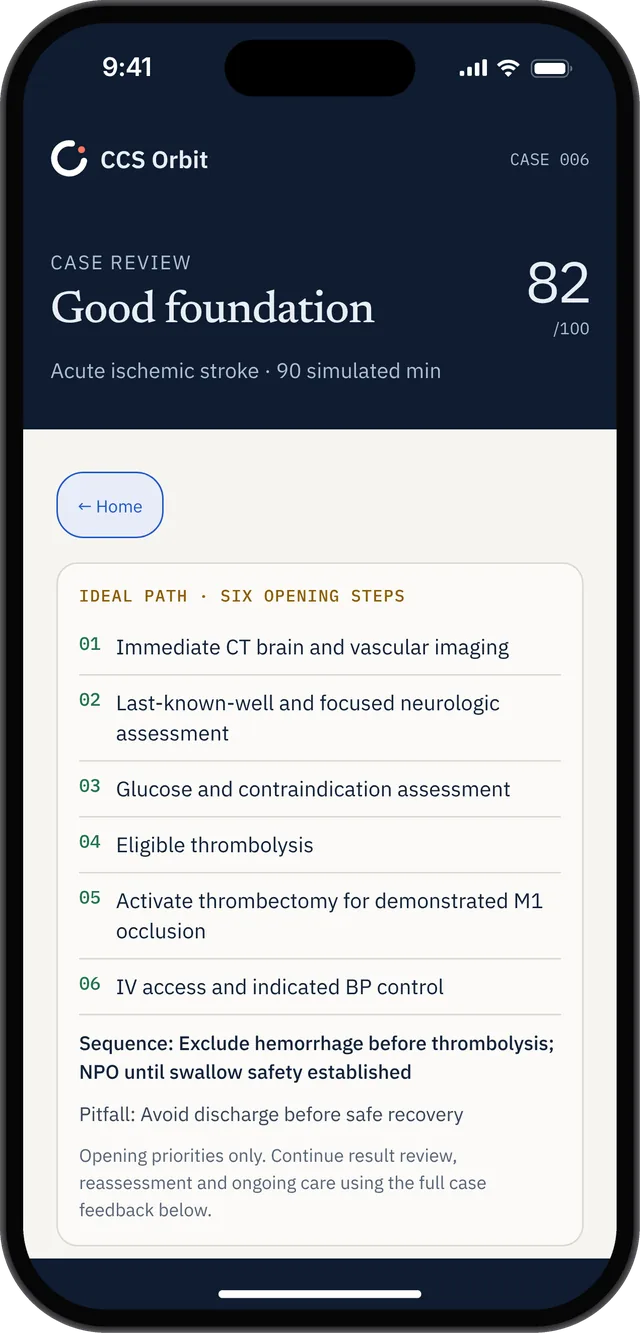
A case-specific ideal path summarizes six opening priorities and a sequencing reminder for the sample stroke case.
FAQ
Should I really place the same opening orders every time?
You should have the same starting frame every time — support what is failing, get access, establish monitoring — and then adapt. The frame is what removes hesitation; the adaptation is what makes it clinically correct. What you should never do is apply a memorized set in the face of a contraindication or a detail in the vignette that contradicts it.
Do I lose points for ordering monitoring on a stable patient?
The USMLE does not publish how individual actions are weighted, so treat specific claims about deductions with caution. Clinically, monitoring should match the patient's acuity — continuous cardiac monitoring for a well outpatient is not defensible management, and appropriateness is part of what the format assesses.
Can I place all five orders in one entry?
Yes. The CCS order sheet accepts a list in a single free-text entry — the USMLE's own walkthrough demonstrates typing several orders at once — and each is then confirmed individually, with a route or frequency selected where relevant. See the order entry guide.
What if I do not recognize the presentation?
Fall back on the three generative questions: what could kill this patient soon and what would I do about it, which single result would most change my next action, and what will tell me if they are improving. That produces a defensible opening for a presentation you have never seen, which is more than a memorized table can do.
Do I need to know drug doses for these orders?
Not in this format. According to the USMLE's walkthrough of running a CCS case, the software optimizes dosages — you select the agent and its route of administration, and the frequency where prompted. The judgment being tested is which drug, by which route, and when.
Keep reading
Sources
- USMLE, Computer-based Case Simulations — order sheet mechanics, orderable categories, case-end restrictions.
- USMLE, How to Run a Step 3 CCS Case (video transcript, PDF) — batch order entry, route selection and dosage optimization.
- USMLE, Step 3 Exam Content — Day 2 structure and per-case real-time limits.
Clinical content is provided for exam-preparation purposes only and is not medical advice. Initial management should follow current guidelines from the relevant specialty bodies and the specifics of the individual patient.
Build recall alongside this workflow: search the free CCS mnemonic database, with practical accuracy notes and downloadable PDF and CSV.