
CCS Patient Location: When to Admit, Transfer to ICU or Discharge
Match the care setting to what your patient needs now. A practical guide to location decisions, escalation, discharge and follow-up in Step 3 CCS.
You have recognized the problem and started treatment. Is the patient still in the right place? Patient location in Step 3 CCS is a management decision: match the setting to the patient's current risk, treatment and monitoring needs. This guide gives you a practical way to think through admission, ICU transfer and discharge, then practice those decisions in CCS Orbit.
Key takeaways
- Ask what care the patient needs now, rather than choosing a location from the diagnosis alone.
- Reconsider disposition after important results, treatment response or deterioration.
- Moving a patient is one part of the plan. Keep track of the treatment, monitoring and reassessment still needed.
- Arrange location changes and follow-up appointments before the official case-end screen, when those controls become unavailable.
- Use Orbit to practice the decision and review its consequences; use the official USMLE software to rehearse the examination controls.
What locations are available in official CCS?
The official simulation uses five care locations: office, home, emergency department, inpatient unit and intensive care unit. Surgical and labor/delivery facilities also exist, but they are not direct transfer destinations; the simulated staff arrange access when indicated.
Think of those five locations as different care settings, not a ladder you must climb in every case. An outpatient encounter may remain outpatient. An acute presentation may require hospital care. A patient's needs can change during the encounter.
How to choose a setting: four questions
Before changing location, pause long enough to explain the decision to yourself. This is a study framework, not an official scoring checklist.
1. Is the patient stable enough for the proposed setting?
Look at the overall picture: circulation, breathing, mental status, symptoms and the trajectory. One improved result does not erase an unresolved threat. Equally, a familiar diagnosis does not automatically justify the most intensive setting.
Ask: What finding makes this move appropriate now? If the answer is only “the diagnosis usually goes there,” revisit the information in front of you.
2. What treatment must continue?
A patient who still requires hospital treatment needs a setting that can deliver it. A transfer should connect to an ongoing plan: what continues, what changes and what must happen next?
Do not let the location selector become the whole response to a sick patient. Recognize the immediate treatment priorities as well as the destination.
3. How closely must the patient be monitored?
Consider the risk of deterioration and how quickly you would need to respond. A patient needing intensive organ support is different from a stable patient requiring routine inpatient care. The useful question is whether the proposed setting can safely support the anticipated course.
For home care, also consider whether the patient can manage the plan and return for help. Physiological improvement is only one part of a safe disposition.
4. What evidence will trigger the next decision?
Choose what to reassess before moving on. If you admit, what change would make you escalate? If you are considering discharge, what needs to be demonstrated first? A disposition plan should include a way to recognize that it is no longer appropriate.
Our CCS reassessment guide explains how to connect treatment, response and the next management decision.
Office, ED, ward, ICU or home: a practical decision table
These are clinical reasoning prompts for practice. They are not automatic admission rules or substitutes for the full case.
| Setting | When to consider it | Question to answer before choosing it |
|---|---|---|
| Office | Assessment, treatment or follow-up that can be managed safely as an outpatient | Is there an acute problem that needs urgent hospital care instead? |
| Emergency department | Urgent assessment and initial management of an acute problem | What needs to be addressed immediately, and what will determine ongoing disposition? |
| Inpatient unit | Continued hospital treatment, observation or monitoring without an ongoing need for intensive care | What specifically prevents safe outpatient care? |
| ICU | Critical illness requiring intensive monitoring, support or rapid intervention | Which unresolved problem requires that level of care? |
| Home | A safe outpatient plan after assessment or treatment | Are the response, treatment plan, follow-up and return instructions adequate? |
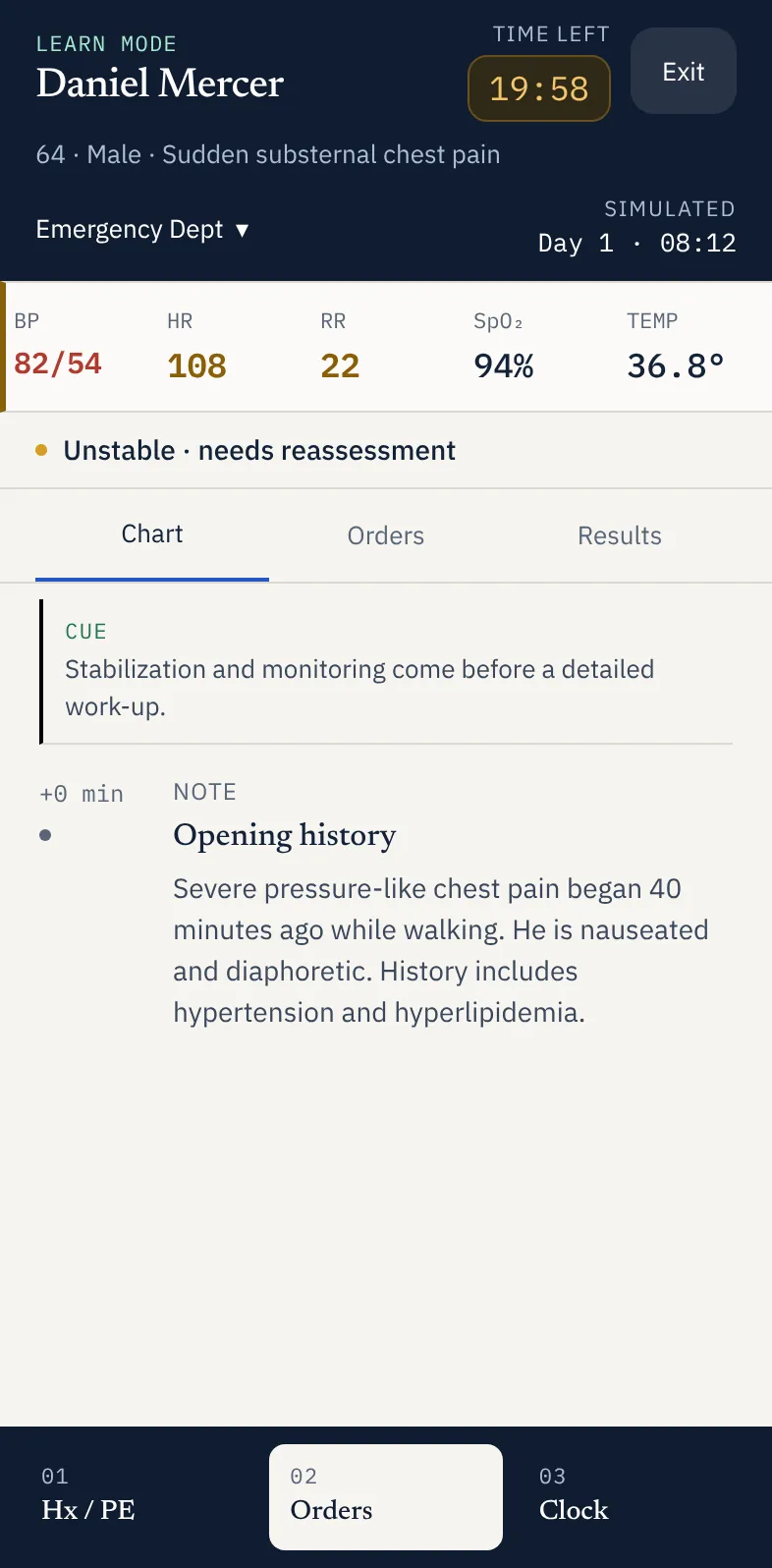
Worked example 1: an office patient who needs urgent hospital care
Imagine an office encounter in which the patient has acute chest pain, appears unwell and is hypotensive. This is not simply an outpatient investigation to schedule around the next available appointment.
The location question is: does the current setting match the urgency? Recognize the need for urgent hospital assessment while addressing immediate management. If subsequent findings show a need for intensive support, reconsider the destination again.
The lesson is the sequence of decisions: recognize risk, begin appropriate care, choose a suitable setting and keep reassessing. A destination alone does not demonstrate that you have managed the problem.
Worked example 2: an improving inpatient who still needs hospital care
Now imagine a postoperative patient whose immediate problem is improving. The patient still needs inpatient treatment and observation, but the scenario no longer shows an ongoing requirement for intensive support.
Ask what remains necessary. A ward may be appropriate if it can provide that care safely; home may be premature if important inpatient needs remain. Review pain control, relevant monitoring and the ongoing treatment plan as part of the decision.
The useful habit is to justify both directions: why does the patient still need hospital care, and why is intensive care no longer necessary? Avoid treating every improvement as a discharge signal.
Worked example 3: an outpatient encounter that can stay outpatient
Consider a stable patient attending for chronic disease follow-up. There are no acute symptoms or findings requiring emergency evaluation, and the assessment supports outpatient management.
The task may be to refine treatment, explain the plan, arrange relevant testing and schedule follow-up. Hospital admission does not become useful merely because the condition is important. Practice recognizing when careful outpatient care is the appropriate management choice.
These examples are deliberately incomplete. Their purpose is to show the reasoning question, not prescribe a destination for every patient with a similar label.
Discharge: turn improvement into a plan
Before sending a practice patient home, use this pre-discharge check:
- Response: what evidence supports a safe outpatient course?
- Remaining needs: is any unresolved problem still keeping the patient in hospital?
- Treatment: what should continue, change or stop?
- Follow-up: when and where should the patient be reviewed, and who will act on pending results?
- Return instructions: which symptoms or changes require earlier help?
Match each item to the patient. A long list of generic counseling orders is not a replacement for a coherent discharge plan.
Official CCS has an important timing constraint: once case-end instructions appear, you cannot change location, schedule a follow-up appointment, obtain examination findings or see pending test results. You can still review the chart and add or cancel orders. Complete disposition and appointment decisions earlier. See our final two minutes guide for the closing workflow.
Follow-up and return visits: watch what the software confirms
An appointment is a specific event to arrange and confirm. In the official instructional demonstration, stopping time advancement after a patient update cancels the previously scheduled appointment; the presenter then arranges an earlier review.
The practical lesson is to read the messages. If the patient's course changes, check the appointment state as well as the clinical plan. Do not assume that an earlier booking still exists or remains suitable.
Common location mistakes to look for in your debrief
| Mistake | Better practice habit |
|---|---|
| Keeping an acutely unwell office patient on a routine follow-up pathway | Reassess whether the encounter requires urgent hospital care |
| Choosing ICU automatically for every serious diagnosis | State the current support or monitoring need that justifies it |
| Discharging after one improved finding | Review the overall response and remaining care needs |
| Moving the patient and forgetting the rest of the plan | Recheck ongoing treatment and monitoring after the move |
| Waiting until case end to arrange disposition | Make the decision while the relevant controls are available |
| Treating a simulator's percentage as an official location penalty | Read the case explanation and identify the underlying management issue |
There is no public universal points table for choosing each destination. Evaluate the clinical decision in context rather than trying to collect credit for moving through more locations.
Practice location decisions in CCS Orbit
CCS Orbit makes location part of the patient-management loop. Follow the patient state, choose a care setting, review the response and examine feedback afterward. Its debriefs cover diagnosis, treatment, monitoring, timing, sequencing and location, helping you investigate where a reasonable plan became delayed, incomplete or unsafe.
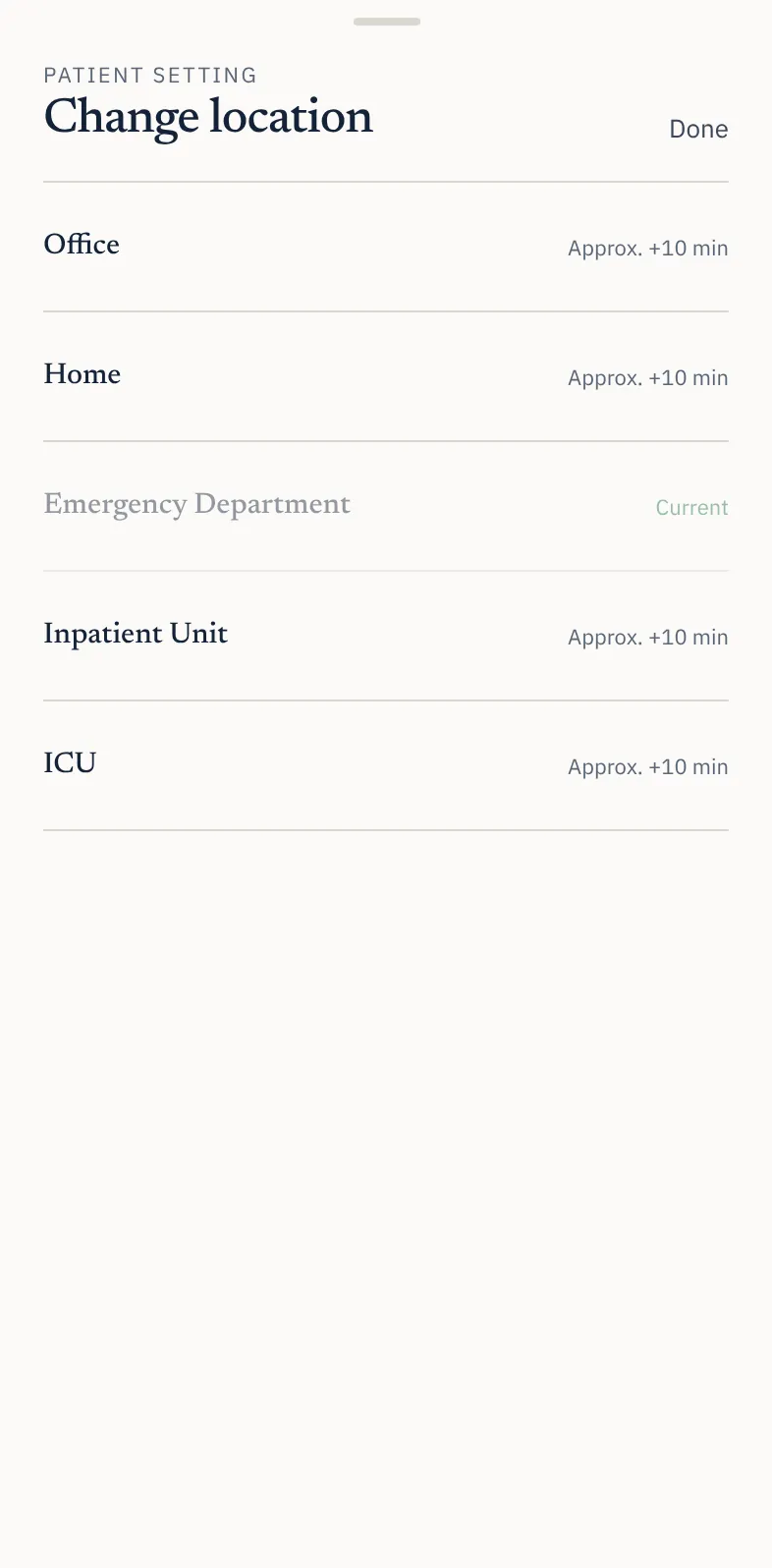
For a targeted session, choose one location decision to explain before making it. After the case, compare that explanation with the debrief. If a problem recurs, use your Error Log and Decision Profile to guide the next attempt. Our case-review routine shows how to carry that learning forward.
Orbit brings 120+ cases to iPhone at launch, with offline cases and debriefs, Save & exit, and Learn and Exam modes. It is coming soon to the App Store, with three complete free cases, a US$34.99 non-renewing 60-day Exam Pass and US$59.99 lifetime access. Explore the app or get the launch email.
Sources and further reading
Official software guidance checked October 20, 2026. The decision framework and fictional examples are CCS Orbit educational guidance; Orbit's interface and training scores do not reproduce the official examination software or proprietary algorithm.