
USMLE Step 3 for IMGs: Eligibility, H-1B Timing, and CCS Practice
Step 3 eligibility for international medical graduates, the H-1B timing question, 2025 pass rates, and a practical CCS preparation plan.
For international medical graduates, Step 3 isn't just the last licensing exam. It can affect your visa options and how a program evaluates your application, and how much you'll have on your plate as an intern. This guide to Step 3 for IMGs covers who can sit it, when sitting it early makes sense, and the part of the exam where US-specific habits matter most: the CCS cases.
You're far from alone. In 2025, 14,304 graduates of non-US and non-Canadian schools sat Step 3, about 39% of everyone who took it.
Can IMGs take Step 3 before residency?
Yes. USMLE's eligibility rules don't require you to have started residency. To apply for Step 3 as an IMG, you need:
- Passing results on Step 1 and Step 2 CK
- A medical degree (or its equivalent) from a school listed in the World Directory of Medical Schools
- ECFMG Certification, with a valid, unexpired ECFMG Certificate
USMLE recommends that applicants have completed, or nearly completed, at least one year of accredited US graduate medical education. It's a recommendation, not a requirement, and many IMGs sit Step 3 before starting residency.
Some practical details:
- Where you sit it. Step 3 is administered in the United States and its territories, unlike Step 1 and Step 2 CK. If you live abroad, you'll need to travel to a US testing center, with a visa that lets you enter the country.
- Cost. The Step 3 application fee is $955 for eligibility periods ending in 2026 and 2027.
- Eligibility period. You choose a three-month window when you apply. Rescheduling within that window is allowed, but there's a fee if you change within 45 days of your appointment.
Why IMGs sit Step 3 before residency
1. The H-1B visa
This is the big one. Programs that sponsor residents on an H-1B visa generally require you to have passed Step 3 before their physician H-1B petition proceeds, subject to the role and other requirements.
The reason is in the regulation. For a physician who will provide patient care, 8 CFR 214.2(h)(4)(viii) requires that a foreign medical graduate has passed "the Federation Licensing Examination (or an equivalent examination as determined by the Secretary of Health and Human Services)". In practice, the USMLE sequence can satisfy this examination requirement. The American Psychiatric Association's guidance for IMGs puts it simply: programs commonly require a Step 3 pass for clinical H-1B sponsorship.
The main alternative is the J-1, which ECFMG sponsors. It doesn't require Step 3, but it comes with a two-year home-country physical presence requirement after training, which many physicians later have waived.
Which is better for you is a question for your program and an immigration attorney, not for a prep website. What matters here is that Ask each program when it requires a Step 3 result for H-1B sponsorship.
2. A stronger application
A passed Step 3 shows programs that you can clear US licensing exams and won't hold up your own H-1B. Passing Step 3 can help a program assess your readiness and can meet a visa-related requirement, but there is no guarantee that it improves interview or Match outcomes.
3. A lighter intern year
Step 3 during intern year means studying around night shifts. Sitting it beforehand, while you have more control over your time, removes that burden.
The case against sitting it too early
Sitting early isn't automatically right. Weigh these against the benefits:
- CCS rewards US clinical habits. If you've never worked in a US hospital or clinic, US clinical workflows, prevention, and reporting duties may not come naturally. More on this below.
- Failing costs more than waiting. In 2025, 88% of first-attempt IMGs passed Step 3, but only 63% of IMG repeat takers did. A failed attempt also appears on your USMLE transcript, and many state boards cap the number of Step 3 attempts they'll accept for licensure.
- Money and travel. $955 plus flights and a US stay is a lot to spend on an attempt you weren't ready for.
A useful self-check: could you sit the official sample CCS cases today and explain every order you'd place, including the outpatient follow-up? If not, build more CCS practice into your plan.
Step 3 for IMGs targeting H-1B programs: work backwards
If H-1B is your goal, start from the date your result has to exist and count back:
- The deadline. Some programs need your passing result before they finalize their rank lists, and the Match rank-order list deadline changes by cycle. Ask each program what it needs and when. Some want it earlier.
- Results. USMLE says results are usually available within four weeks, but advises allowing at least eight weeks if a deadline depends on them.
- Testing date. So aim to test at least eight weeks before the program's deadline, and ideally earlier to leave a buffer.
- Scheduling. Book as soon as your scheduling permit arrives. Testing centers fill up, particularly in popular cities.
- Preparation. The AMA's guidance suggests 90 to 120 days of preparation for most candidates, and more if you've been out of clinical practice.
Planning for 2029 or later? USMLE is moving to designated testing dates from January 2029. That will make "I'll just push it back a few weeks" much harder, so build extra buffer.
Step 3 for IMGs: why CCS needs extra practice
The multiple-choice questions test medicine that's broadly international. CCS tests how medicine is practiced in the US system, which is harder to learn from books. These are the areas where US-specific workflows can require extra practice:
Location of care
Location of care matters in CCS, not just what you do. Office, emergency department, ward, ICU or home: the choice should match the patient’s condition.
For example, a patient with septic shock belongs in the ICU. A stable patient with nonpurulent cellulitis goes home with oral antibiotics and a marked margin. A child with croup who responds to treatment can go home, but only after an observation period. Health systems differ in who gets admitted, so use the US standard rather than the one you trained in.
US screening and prevention
Office cases may include US preventive care: vaccine schedules, screening intervals, counseling. Examples include the zoster vaccine at follow-up after shingles, colonoscopy and upper endoscopy for iron deficiency in a postmenopausal patient, and a developmental screen at a six-month well-child visit.
Reporting and safeguarding duties
Reporting obligations vary by jurisdiction and presentation; in a practice case, consider: public health notification for reportable infections, partner services for STIs, Adult Protective Services for elder neglect, and child protection reports. If these aren't part of your usual workflow, they're easy to forget in a timed case.
Consults and counseling
US-style management often includes named consultations (cardiology, the stroke team, poison control) and explicit patient counseling orders. In CCS these are actions to consider where appropriate. Thinking them isn't enough; you have to order them.
The fix is exposure, not reading. Run enough full cases, especially office and follow-up cases, that US-style disposition and preventive orders become automatic.
A practical Step 3 plan for IMGs
- Weeks 1–2: Do USMLE's free sample questions and the six official CCS cases. Note which of the app’s feedback categories you drop.
- Weeks 2–8: Work through a question bank for the multiple-choice portions of the exam. Day 1 covers biostatistics, epidemiology, ethics and patient safety, which some curricula outside the US cover less heavily.
- Weeks 4–10: Do CCS cases alongside, two or three a day. Deliberately include office, pediatric and obstetric cases, not just emergencies.
- Final two weeks: Timed runs of several cases in a row, and a review of US vaccine and screening schedules.
Read how CCS is scored early, so you know what you're practicing for.
Practice the CCS portion
CCS Orbit brings 120+ interactive cases to iPhone at launch, with Learn and Exam modes, six-domain debriefs and review tools for recurring mistakes. Cases and debriefs work offline. Three cases are free; Orbit Plus offers a one-time US$34.99 60-day Exam Pass or US$59.99 lifetime access. Explore the app and get its launch email.
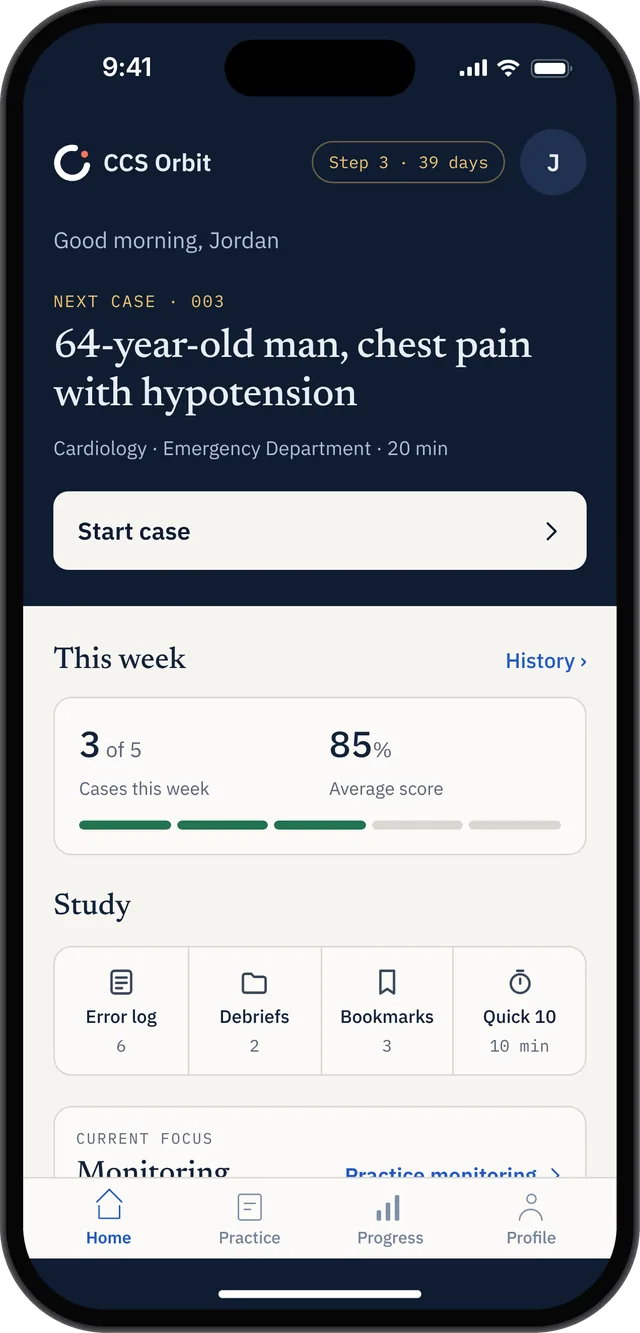
The next-case preview and study shortcuts help organize full case attempts and shorter reviews on iPhone.
Key takeaways
Step 3 for IMGs is a strategic decision as well as an exam. You can sit it before residency once you have Step 1, Step 2 CK and ECFMG Certification, and passing it is commonly necessary for an IMG seeking a clinical H-1B training position. Sit it when you're ready rather than as early as possible, because the repeat-taker pass rate drops sharply. Put deliberate practice into CCS, where US-specific habits around location of care, prevention and reporting carry real points.
Frequently asked questions
Can IMGs take Step 3 without residency?
Yes. International medical graduates can take Step 3 once they have passed Step 1 and Step 2 CK, hold a medical degree from a school in the World Directory of Medical Schools, and have a valid ECFMG Certificate. USMLE recommends, but doesn't require, at least one year of US graduate medical education first.
Do I need Step 3 for an H-1B visa?
In most cases, yes. For H-1B physicians providing patient care, federal regulation requires passing the Federation Licensing Examination or an equivalent approved by HHS, and programs commonly require completion of the USMLE sequence. Programs that sponsor H-1B visas therefore usually need a passing Step 3 result before their physician H-1B petition proceeds, subject to the role and other requirements.
Where can IMGs take Step 3?
Step 3 is only administered at testing centers in the United States and its territories. Unlike Step 1 and Step 2 CK, it can't be taken at international Prometric centers, so candidates living abroad have to travel to the US to sit it.
What is the Step 3 pass rate for IMGs?
In 2025, 88% of graduates of non-US and non-Canadian medical schools passed Step 3 on their first attempt, according to USMLE's performance data. Among IMG repeat takers, the pass rate was 63%.
How much does Step 3 cost for IMGs?
The Step 3 application fee is $955 for eligibility periods ending in 2026 or 2027. It's the same for all applicants. IMGs living outside the US should also budget for travel to a US testing center, and there's a fee for rescheduling within 45 days of the appointment.
Official sources and further reading
- usmle.org — eligibility
- usmle.org — performance data
- usmle.org — applying scheduling
- fsmb.org — step 3 application fees
- fsmb.org — state licensure
- psychiatry.org — visa and immigration basics for imgs
- ama-assn.org — usmle step 3 faqs when take exam how prepare
- usmle.org — expiration ecfmg certificates and impact usmle eligibility
- uscis.gov — volume 2 part p chapter 6